Most well-known video downloaders for Android are not on Google Play. They live on their own sites and third-party APK stores, installed and updated by hand. That changes what “best” means: the app matters, but so do the install path and the update story. This guide compares eight downloaders — Kite: Video Downloader, Seal, YTDLnis, Snaptube, VidMate, TubeMate, Videoder and InsTube — on what they save and what living with each one is like. Kite is our app, so read the verdicts here as our honest, sourced case rather than a neutral review.
How we chose
We judged every app on the same five points.
- Install path and update story. A Play app updates itself. Open-source apps update through F-Droid or GitHub. A sideloaded APK updates only when you fetch a new file yourself, and each install passes Android’s unknown-source consent and Play Protect scan.
- Formats and MP3 output. Which resolutions and containers an app offers, and whether it can save just the audio.
- Download management. Pause and resume, queues, Wi-Fi-only switches, scheduling.
- Playback. Whether the app can play what it saves, or hands the file to another player.
- Privacy features. Accounts, private spaces, and what stays on the device.
Every competitor claim below comes from that app’s own listing, site or repository, checked in August 2026; the exact pages are cited at the end of this article.
1. Kite: Video Downloader — the one on Google Play
Kite is the only app in this list installed from Google Play, so it updates itself and never shows a sideload prompt. The flip side is policy: there are certain large video and music platforms that Google Play policy does not allow downloader apps to touch, and Kite deliberately excludes them. If those platforms are your main source, know that before you install.
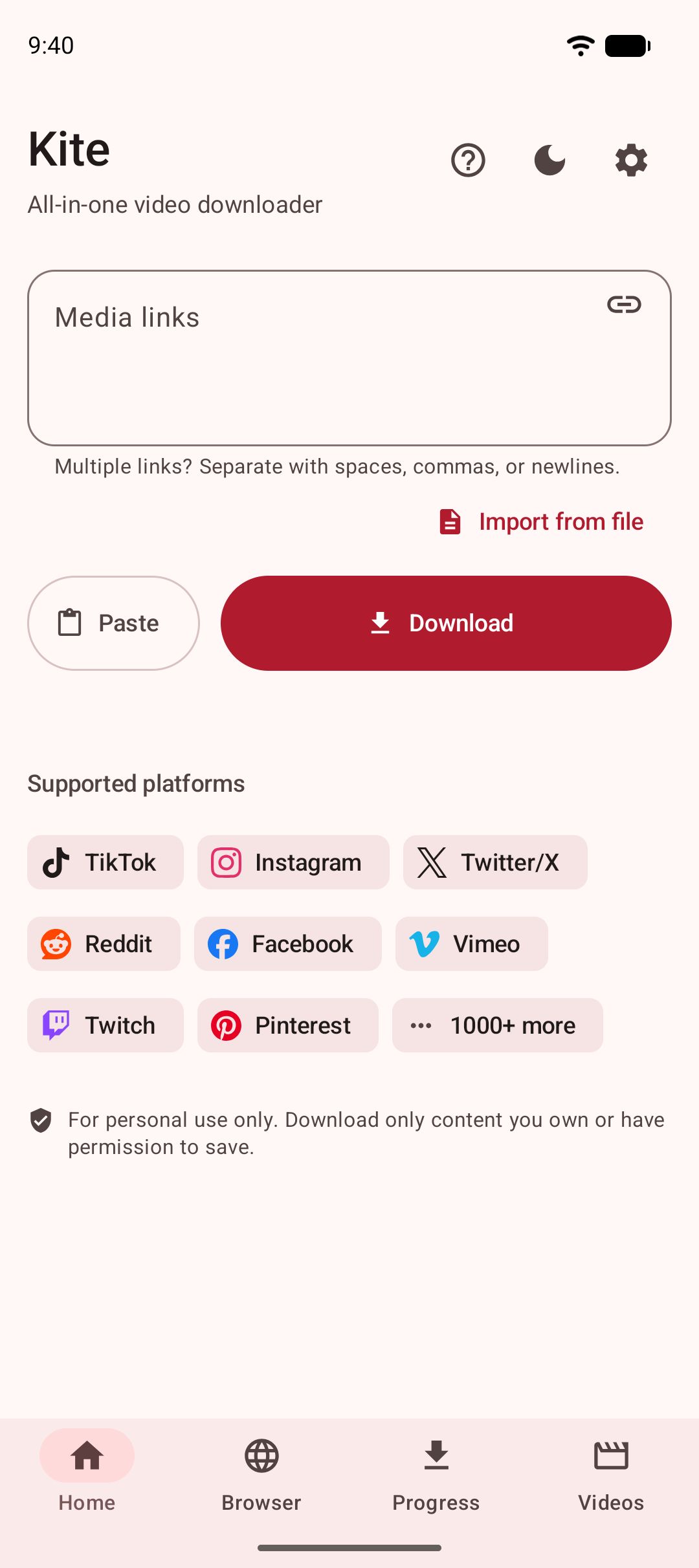
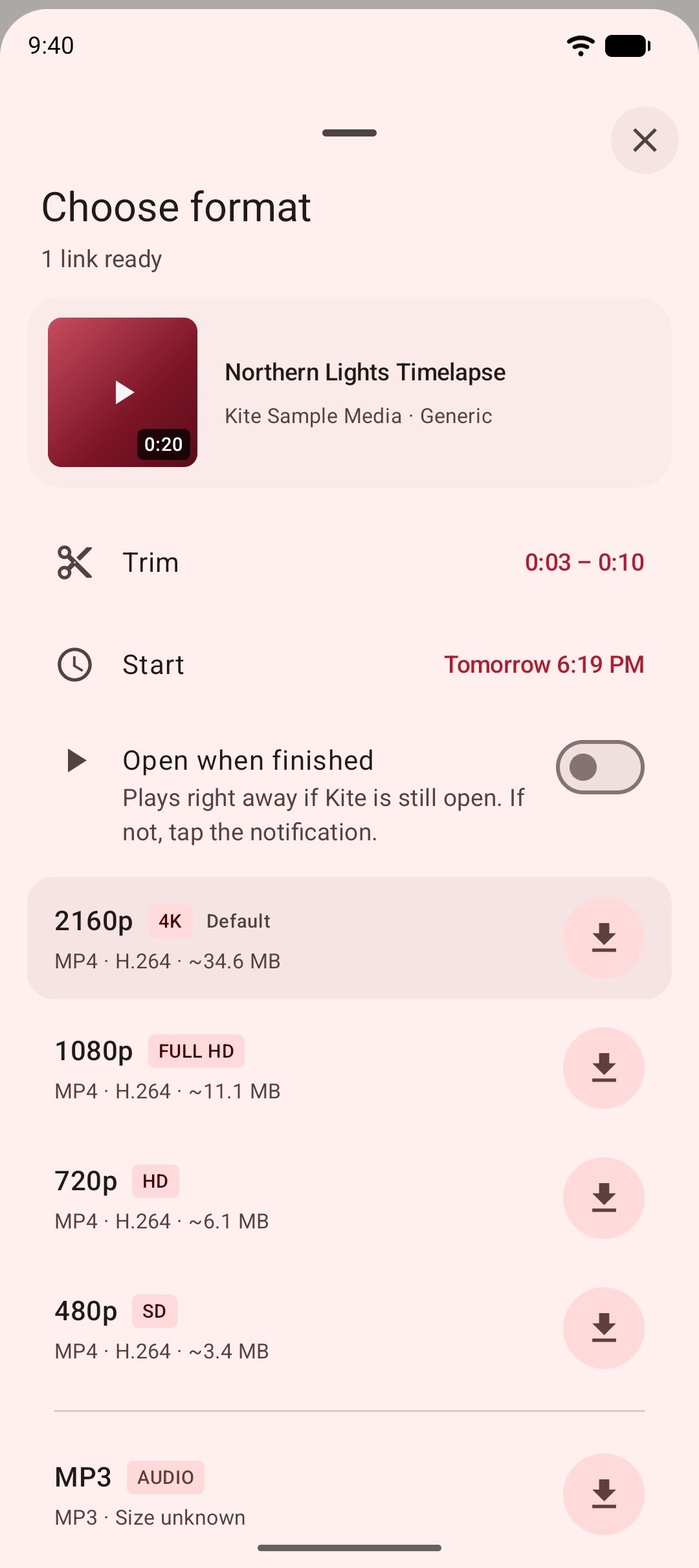
For everything else, the flow is short. Paste a link and Kite works out what is on the page: it lists every resolution the source offers, from SD up to 4K with container, codec and estimated size, or pulls the audio out as an MP3 with title and artist metadata embedded. It can also convert a video you have already saved into an MP3. The yt-dlp engine runs entirely on the phone and recognises TikTok, Instagram, X (formerly Twitter), Reddit, Facebook, Vimeo, Twitch and Pinterest, plus a thousand or so other sites; a built-in browser spots playable media on pages and offers to save it. Playlist links are expanded item by item, and subtitles can be embedded.
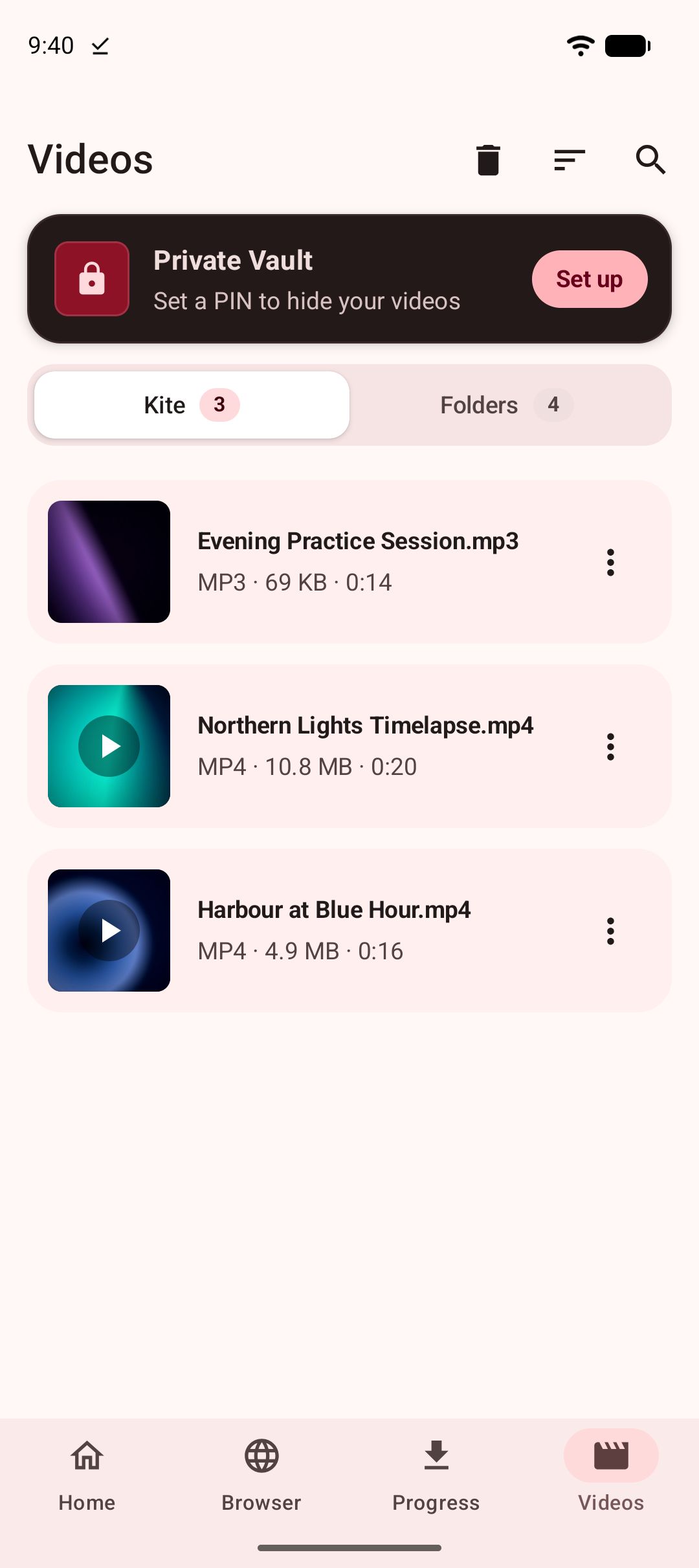
Downloads run up to three at once with live speed and time remaining in the notification shade; they survive closing the app and resume after an interruption. There is a Wi-Fi-only option, scheduled downloads, and a trim range for saving part of a video. Saved files land in a library with a real player: swipe gestures, hold for double speed, picture-in-picture, a playback queue, and MP3s that keep playing with the screen off. A Private Vault stores chosen files PIN-locked and encrypted, hidden from the gallery, and everything in it stays on this device. Kite does not bypass copy protection of any kind: material protected by DRM is declined rather than downloaded.
The honest negatives: Kite is free and supported by ads — banner and the occasional interstitial — with no paid tier to switch them off; the platform exclusions above are a hard line. There is no account or sign-up, and it runs on Android 7.0 or newer.
2. Seal — the open-source pick
Seal is a free, open-source downloader built on yt-dlp, licensed GPL-3.0 and distributed through GitHub releases and F-Droid; it is not on Google Play (as of August 2026). Its README states it will always be free and open source; the project runs on donations.
The feature set is focused. Seal downloads video and audio from the sites yt-dlp supports, embeds metadata and the video thumbnail into extracted audio files, embeds subtitles into videos, and downloads a whole playlist in one click. Power users get custom yt-dlp command templates, plus an embedded aria2c as an alternative downloader. The interface is Material Design 3 with dynamic colour.
The newest F-Droid build is 1.13.1, added in January 2026; GitHub carries stable and pre-release APKs (as of August 2026). F-Droid flags one anti-feature — Seal relies on the GitHub API to check for and fetch yt-dlp engine updates. That is the open-source trade: full source visibility, and updates you manage yourself. Seal requires Android 5.0 or newer.
3. YTDLnis — the power user’s downloader
If Seal is focused, YTDLnis is the full toolbox. It is a free, open-source downloader under GPL-3.0 that uses yt-dlp, runs on Android 7.0 and above, and is distributed through GitHub, F-Droid, IzzyOnDroid and Uptodown — which its README lists as the only trusted sources. It is not on Google Play (as of August 2026).
The feature list is long and concrete. Playlists can be processed item by item: edit every entry separately, apply a shared format, path and filename template, or batch-switch entries between audio, video and custom commands. There is a queue with scheduling by date and time, multiple simultaneous downloads, and cookie support that reuses your own logins for private or premium-format material. It can cut downloads by timestamps or chapters (experimental), strip SponsorBlock segments or embed them as chapters, and embed subtitles, metadata and chapters. A share-menu card downloads without opening the app, a .txt file imports links in batches, and there is a built-in terminal, download logs and an incognito mode. A plugin system swaps in components such as Python, NodeJS, FFmpeg and aria2c.
Development is active, with commits as recent as August 2026. The cost is surface area: there is far more to learn here, and for its intended user that is the appeal.
4. Snaptube — the search-first sideload incumbent
Snaptube is built around search: type a video or channel name, then pick a format and quality per result from a popup. Downloads save as MP4, or MP3 for audio, with typical quality options of 320p, 480p, 720p and 1080p, sometimes 4K, per its Uptodown listing (as of August 2026). An “Add Website” button bookmarks further portals, though the review notes user-added sites are not guaranteed to work. Settings cover a download-folder chooser, a maximum speed limit, a Wi-Fi-only option, an app language switch and a Night Mode. No account is required.
Distribution is the other half of the story: Snaptube is an APK through third-party stores such as Uptodown rather than Google Play, so installs go through sideload prompts and updates are manual. Uptodown’s review also notes that in some regions results and downloads appear only over a VPN. The listing prices it as free under a proprietary licence and does not state how the app is monetised. The current build is 7.63.0.76330710, dated 23 July 2026, for Android 5.0 and newer. If that install path puts you off, we keep a separate list of alternatives to Snaptube.
5. VidMate — a sites grid and a floating bubble
VidMate organises itself around a Sites tab with shortcuts to more than a dozen video pages. Open one and a floating red download bubble appears while a video plays; tapping it saves MP3 or MP4, with 720p and 1080p typical and up to 4K on some platforms (per its Uptodown listing, as of August 2026). The extras are real: an integrated music player with playlists and a sleep timer, a default playback-quality setting, and a Pop-Up mode that plays video in a floating window over other apps.
VidMate is distributed as an APK through third-party stores such as Uptodown rather than through Google Play; the listing prices it as free and does not state how it is monetised. And per Uptodown’s editorial review, VidMate’s Restricted Mode — which hides adult-content pages and videos — is switched off by default. The current build is 6.0102, dated April 2026, for Android 5.0 and newer.
6. TubeMate — the long-running format switchboard
TubeMate is on its third major version, “TubeMate3”, which per Uptodown’s review differs from TubeMate2 only in interface. Its strength is format choice: MP4, MP3, AAC, OGG and WEBM output, audio at 48k, 128k or 256k, video from 144p to 1080p, and an optional setting that enables 8K downloads (as of August 2026). A drop-down lists the supported sites, a red pop-up button appears when a video is detected, and there is a subtitle download option for videos that carry them. Settings include Wi-Fi-only downloading, a maximum speed limit, a storage-folder chooser and a Dark Mode.
Read the install path closely. TubeMate is installed from an APK from tubemate.net or a store such as Uptodown, not from Google Play, and its own website tells users to ignore the Google Play Protect warning that appears during installation (as of August 2026). We state that as the site presents it; how you weigh such an instruction is part of choosing a sideloaded downloader. The current build is 3.4.22.1565, dated 9 August 2026, and it runs on Android 4.4 and newer — the lowest floor in this list.
7. Videoder — search across services, listed build from 2023
Videoder’s pitch is a built-in search engine that combs multiple streaming video services, with per-video quality from 240p to 1080p and output in MP4, FLV or 3GP. MP3 is not among the formats its listing names. It is an APK via Uptodown rather than Google Play, listed as free with no statement of how it is monetised, and runs on Android 4.1 and newer.
The headline fact is the date. The newest Videoder build listed on Uptodown is version 14.4.2, dated August 2023 — no newer version shown in roughly three years (as of August 2026). Sites change constantly and a downloader can only follow them by updating, so test it on your sites before relying on it.
8. InsTube — 100+ sites and a Video Lock
InsTube’s site advertises downloads from more than 100 sites, with resolutions of 360p, 720p and 1080p “and more”, marketed up to 4K (as of August 2026). It is broader than video alone: listed file formats are MP3, MP4, 3GP and M4A plus JPG and PNG, with copy-link detection, batch downloads, site bookmarks for adding sources, and a built-in video and music player. The site states downloads work without login.
The distinctive feature is Video Lock, a private space for hiding videos, music and pictures. If that decides your choice, approaches differ a lot between apps — we compared them in our round-up of private video vault apps for Android.
InsTube installs as an APK from instube.com or the stores its site points to — on some phones it directs users to MI GetApps or the OPPO App Store — not from Google Play (as of August 2026). The homepage lists version 2.6.6, with no release date shown, and does not state how the app is monetised.
Side by side
Every entry reflects the app’s own listing, site or repository as of August 2026.
| App | Where to get it | Price model | Saves MP3 | Built-in player | Notes |
|---|---|---|---|---|---|
| Kite: Video Downloader | Google Play | Free, with ads | Yes | Yes — video, plus background audio | Android 7.0+; PIN-locked encrypted vault |
| Seal | GitHub, F-Droid | Free, open source | Yes | Not advertised | Metadata, thumbnail and subtitle embedding; playlists |
| YTDLnis | GitHub, F-Droid, IzzyOnDroid, Uptodown | Free, open source | Yes | Not advertised | Scheduling, cookies, SponsorBlock, terminal |
| Snaptube | APK via Uptodown | Free; monetisation not stated | Yes | Not advertised | Search-first; may need a VPN in some regions |
| VidMate | APK via Uptodown | Free; monetisation not stated | Yes | Music player and pop-up video | Restricted Mode off by default |
| TubeMate | APK via tubemate.net or Uptodown | Free; monetisation not stated | Yes | Not advertised | Five output formats; optional 8K setting |
| Videoder | APK via Uptodown | Free; monetisation not stated | Not listed | Not advertised | Newest listed build dated August 2023 |
| InsTube | APK via instube.com or partner stores | Free; monetisation not stated | Yes | Yes — video and music | Video Lock private space; version 2.6.6 |
Which one should you pick
You want an all-rounder that installs and updates through Google Play. Pick Kite. You get the quality picker, MP3 extraction, a real player and the encrypted vault in one app; in exchange you accept ads and the deliberate platform exclusions covered above.
You want open source and room to tinker. Pick Seal for a focused downloader, or YTDLnis when scheduling, cookie logins or custom yt-dlp commands are the point. Both are free, run on yt-dlp, and update through F-Droid or GitHub.
You are used to search-first sideload apps. Snaptube and VidMate are the incumbents. Go in knowing that updates are manual, that neither listing states how the app is monetised, and that Snaptube may need a VPN in some regions.
You want the most format switches. TubeMate’s five output formats, three audio bitrates and optional 8K setting are the widest spread here — weigh that against a site that tells you to dismiss a system warning.
Videoder and InsTube are for specific tastes: Videoder if its multi-service search matches how you browse — check it still works on your sites first — and InsTube if image downloads and Video Lock matter more than a store-based install.
If most of what you save is TikTok, watermark handling matters more than formats — we cover that in our guide to TikTok downloaders that skip the watermark.
Whichever you pick, the rule is the same. These are tools for personal use: save only content you own or have permission to save, respect the terms of the sites you visit, and respect the rights of the people who made what you are watching.