TikTok’s built-in save keeps the watermark and is not available on every video. If you want a clean copy of a public video — an archive of your own posts, a clip you have permission to reuse, or simply offline viewing — you need a downloader. In 2026 the real decision splits two ways: web tools that run in a browser tab with nothing to install, and Android apps that wrap a download manager, a library and a player around the same job. This guide compares five options: Kite: Video Downloader, Seal and YTDLnis on the app side, SnapTik and SSSTik on the web side. Kite is our app, so read the verdicts here as our honest, sourced case rather than a neutral review. If you only want the steps, our step-by-step TikTok download guide walks through the whole flow.
How we chose
Every claim about another tool on this page comes from that tool’s own website, README or listing, checked on 11 August 2026 and dated in the text where it matters. No third-party rumours, no guessed numbers.
The comparison rests on the questions that matter for this search:
- Does the saved file come out without the burned-in watermark, and when can that fail?
- What do you get besides MP4 video — MP3 audio, photo slideshows, subtitles?
- How many steps does one save take, and what happens when you want ten?
- What happens after the download — a library and a player, or a loose file in a folder?
One piece of honesty up front, because it applies to all three apps below: an extractor-based app saves the video stream the page actually plays, which for most public TikTok videos is the version without the burned-in watermark; where TikTok serves only a watermarked stream, that is what any downloader gets. No tool on this list, app or web, can produce a clean file that TikTok does not serve. The two web tools advertise no-watermark downloads on their own pages, and we attribute that claim to them rather than restating it as our own finding.
Kite: Video Downloader
Kite is a native Android downloader on Google Play; it requires Android 7.0 or newer (as of August 2026). It is free and supported by ads — a banner and the occasional interstitial — with no account, no sign-up and no subscription tier.
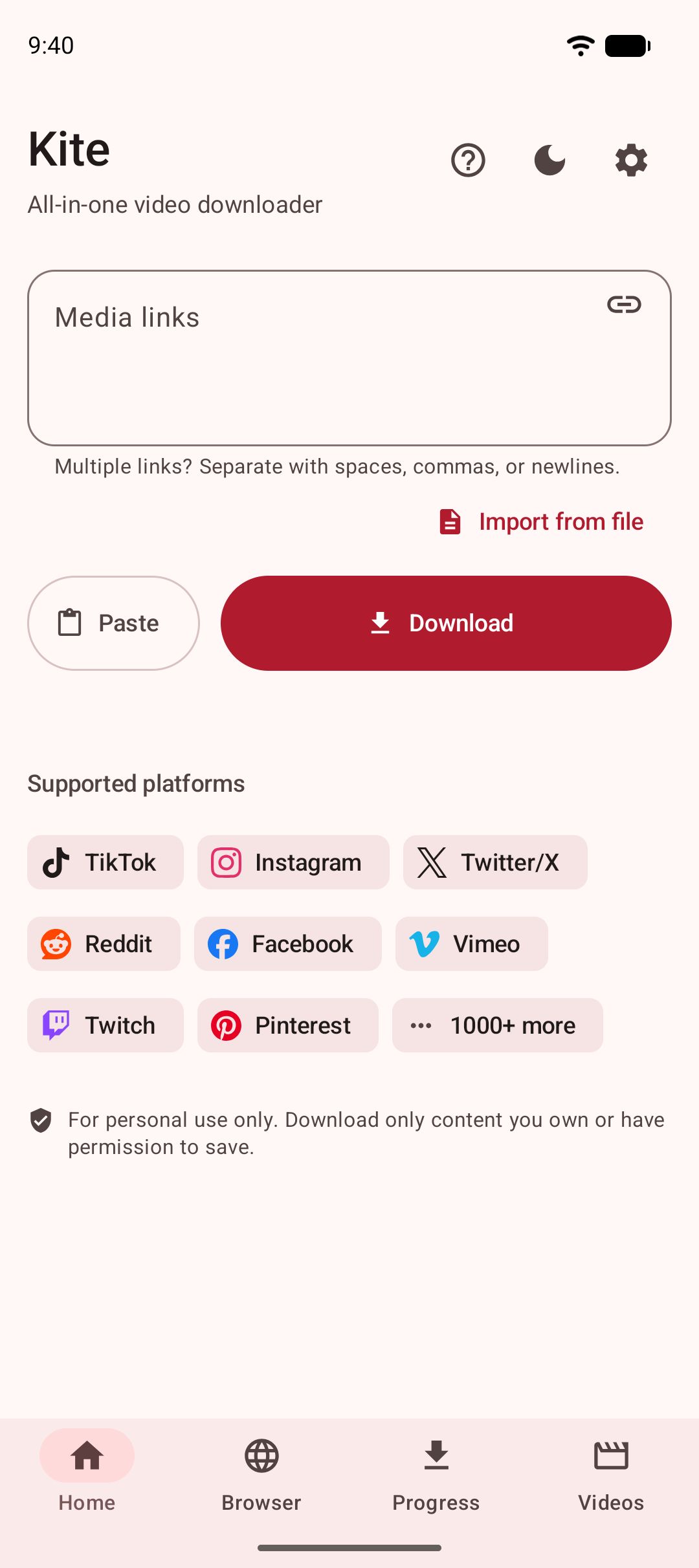
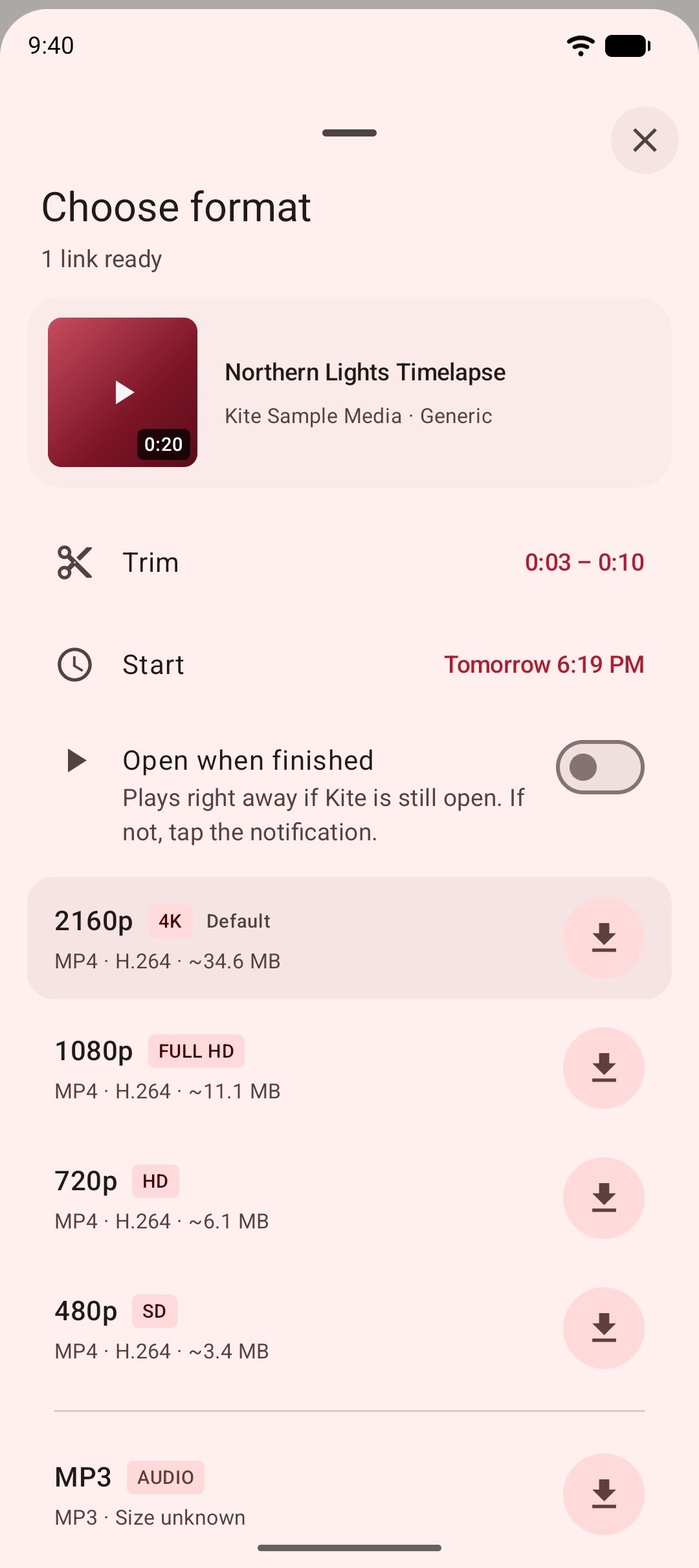
For TikTok there are two routes in. The first is paste: copy a link from the TikTok app, open Kite, paste it, and Kite reads the page with yt-dlp running entirely on the phone. It lists every resolution the source offers, with container, codec and estimated size, or pulls the audio out as an MP3 with title and artist metadata embedded — our video-to-MP3 guide covers that side in detail. The second route is the built-in browser, which spots playable media on the pages you visit and offers to save it, useful when a video reaches you as a web link rather than inside the TikTok app. Beyond TikTok, Kite recognises media pages from Instagram, X (formerly Twitter), Reddit, Facebook, Vimeo, Twitch and Pinterest, plus a thousand or so other sites.
The extractor rule above applies unchanged: for most public TikTok videos the stream Kite saves is the one without the burned-in watermark, and where only a watermarked stream exists, that is what you get.
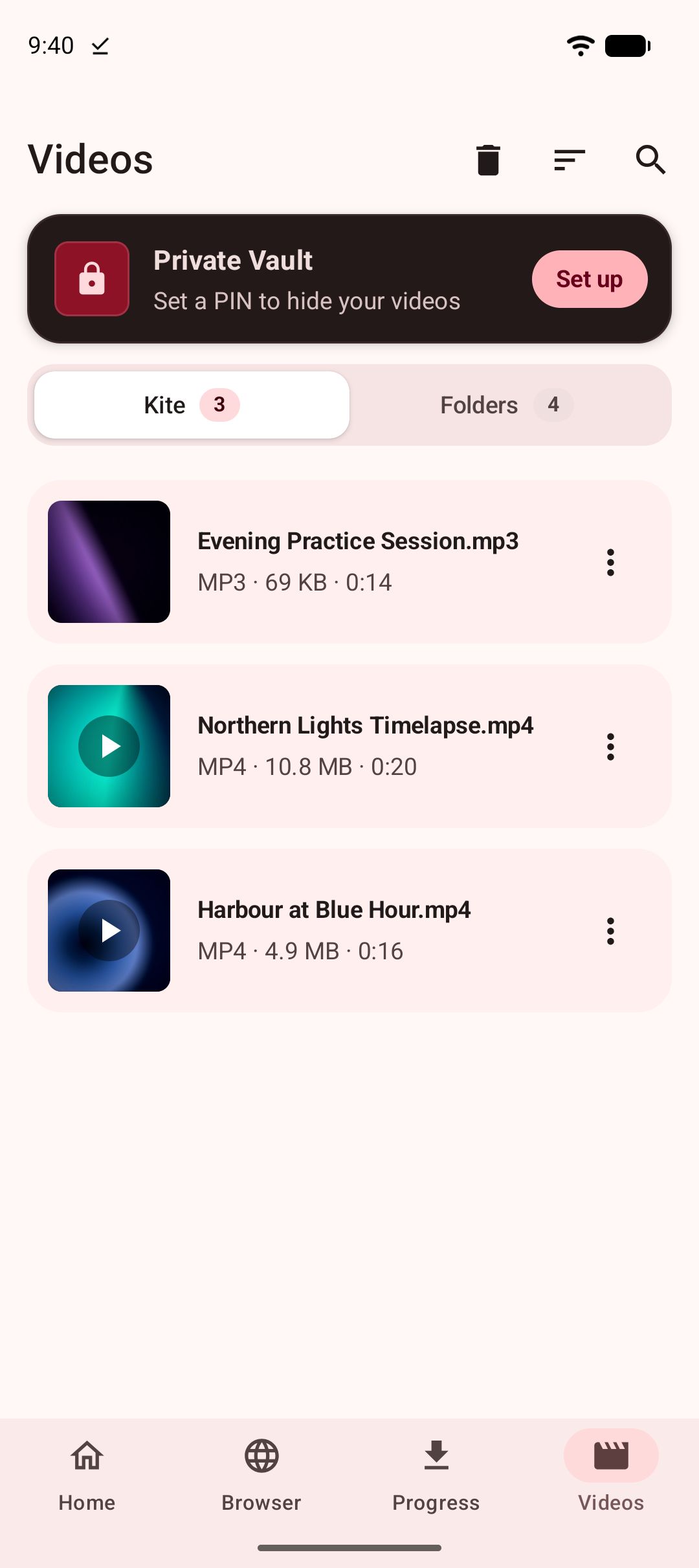
Around the save sits the machinery web tools lack. Downloads run up to three at once, keep running in the background, survive closing the app, and resume after an interruption; there is a Wi-Fi-only option, scheduled downloads, and a trim range for saving part of a video. Finished files land in a library next to the phone’s existing videos and music, grouped by folder and searchable, and open in a built-in player with gestures, picture-in-picture and a queue. Saved MP3s keep playing with the screen off, with controls on the lock screen. A PIN-locked, encrypted Private Vault can hide chosen files from the gallery; everything in it stays on this device.
Two honest limits. Kite deliberately excludes certain large video and music platforms that Google Play policy does not allow downloader apps to touch — TikTok is not affected. And Kite does not bypass copy protection of any kind: material protected by DRM is declined rather than downloaded.
Seal
Seal is a free, open-source Android downloader built on yt-dlp, distributed through GitHub releases and F-Droid rather than Google Play (as of August 2026). The newest build on F-Droid is 1.13.1, added in January 2026, and it requires Android 5.0 or newer.
Seal is built on the same extraction engine, so the same watermark logic applies to TikTok: it saves the stream the page plays, which for public videos is usually the clean one. Its documentation describes one-click playlist downloads, embedding of metadata, thumbnails and subtitles into saved files, an embedded aria2c downloader, and custom yt-dlp command templates for people who want to steer the engine directly (as of August 2026). The interface is a modern Material Design 3 app with dynamic colour, and the project states it will always be free and open source, funded by donations.
The trade-offs are about distribution and pace. Installing means fetching an APK from GitHub or adding F-Droid, not a Play-store install, and F-Droid notes that Seal depends on the GitHub API to check for and fetch yt-dlp engine updates (as of August 2026). If sideloading does not put you off, it is the tidiest open-source pick here.
YTDLnis
YTDLnis is a free, open-source Android downloader that uses yt-dlp and runs on Android 7.0 and above (as of August 2026). It is distributed through GitHub, F-Droid, IzzyOnDroid and Uptodown — its README lists these as the only trusted sources — and development is active, with commits as recent as August 2026.
For TikTok the extractor rule holds once more: public videos usually come out without the burned-in watermark, because that is the stream the page serves. What sets YTDLnis apart is depth. Its README describes playlist processing with per-item editing, a download queue with scheduling by date and time, multiple simultaneous downloads, cutting a download by timestamps, custom yt-dlp commands with a built-in terminal, and a share-menu card that saves a link without opening the app (as of August 2026). It also describes cookie support — signing in with your own account to reach videos that are otherwise unavailable — the closest thing on this list to a documented route to content a logged-out page will not show.
The cost of that depth is Seal’s trade-off plus a little more: an APK install from outside Google Play, and an options surface aimed at people who already know what a yt-dlp template is. As a first downloader it is a lot to take in; for a power user, that is the point.
SnapTik (web)
SnapTik is a free, ad-supported web tool at snaptik.app for downloading TikTok videos without the watermark — that no-watermark promise is the page’s own claim (as of August 2026). There is nothing to install and no account: open the page, paste a TikTok link, and save an MP4, up to Full HD “or higher” when available, per the site. It accepts tiktok.com, vm.tiktok.com and v.douyin.com link formats.
Two details from its own pages are worth knowing. First, SnapTik converts TikTok photo slideshows into MP4 files with the images and music merged (as of August 2026) — the only tool here that advertises that conversion specifically. Second, its FAQ says it does not support downloading multiple videos at once, and that it deliberately does not offer a dedicated music-track download service, citing the rights of the tracks; there is a “Download Audio” button for a video’s own audio. The page also states that it does not store downloaded videos or download histories.
As with every web tool, each save is a round trip through a browser tab, and once the file lands in your Downloads folder the tool’s job is over — no library, no player, no resume. Our SnapTik and SSSTik alternatives guide looks at when that trade stops being worth it.
SSSTik (web)
SSSTik is a free web tool at ssstik.io that downloads TikTok videos without the watermark — again the page’s own claim — and saves them as MP4 or converts them to MP3, in HD when available (as of August 2026). Its page states no app, extension or install is needed and that it works in modern browsers on Windows, macOS and Linux as well as on mobile, which makes it a practical pick when you are at a desktop rather than on a phone. No account is required, and photo downloads are mentioned alongside videos.
Its clearest stated limit: SSSTik cannot download videos from private TikTok accounts — the page says an account must be public for a video to be saved (as of August 2026). That is not unique to SSSTik; it is simply the tool that says it plainly. The browser-tab trade-off is the same as SnapTik’s: fine for one video, tedious for ten, and nothing happens after the file is saved.
Side by side
| App | Type | Where to get it | No-watermark saves | MP3 | Notes |
|---|---|---|---|---|---|
| Kite: Video Downloader | Android app | Google Play | Usually — saves the stream the page plays | Yes, with metadata | Browser, three downloads at once, library, player, vault |
| Seal | Android app | GitHub, F-Droid | Usually — same stream rule | Yes, with metadata | Open source; playlists, subtitles, templates |
| YTDLnis | Android app | GitHub, F-Droid, IzzyOnDroid, Uptodown | Usually — same stream rule | Yes | Open source; scheduling, cookie sign-in, custom commands |
| SnapTik | Web tool | snaptik.app in a browser | Advertised by its page | Audio button only | Slideshows to MP4; one video at a time |
| SSSTik | Web tool | ssstik.io in a browser | Advertised by its page | Yes, MP4 or MP3 | Public accounts only; desktop and mobile |
Which one should you pick
If you save TikToks more than once in a while and you are on Android, an app beats a web tool: links go straight in, saves run in the background, three can run at once, and the result lands in a library with a player instead of a loose file. Kite is our case for that route — a Play-store install with no sideloading, an in-app browser for links that arrive outside the TikTok app, MP3 extraction, and a vault for files you would rather keep out of the gallery. It sits alongside the other Android options in our wider Android downloader round-up.
If open source matters more to you than a Play-store install, Seal is the simpler of the two sideloaded apps and YTDLnis the deeper one — scheduling, per-item playlist editing, cookie sign-in and custom yt-dlp commands, at the price of more to learn.
If you save one video a month, or you are at a desktop, skip the install entirely: SnapTik if you want photo slideshows merged into an MP4, SSSTik if you want a plain MP4-or-MP3 choice in the browser. Both advertise no-watermark output; the extractor rule above explains where a clean copy actually comes from.
Whichever you pick, the same rule applies. These are tools for personal use: save only content you own or have permission to save, respect the terms of the sites you visit, and respect the rights of the people who made what you are watching.