SnapTik and SSSTik do one job, and they do it without asking you to install anything. That is the whole appeal, and it is a real one. People start looking for an alternative when the job stops being one clip and becomes twenty. SnapTik’s FAQ says it does not support downloading multiple videos at once (as of August 2026), so each save is its own round trip: copy the link, switch to the browser, paste, wait, save, go back. SSSTik states that an account must be public before a video can be saved. SnapTik’s page says it shows ads to support the service and asks visitors to turn off ad blockers or donate. And when the file lands, both tools are done with it: no queue, no resume, no library, nothing running while the screen is off.
This guide covers the Android app route, and it is fair to the browser route it replaces. Three apps are compared, starting with our own, Kite: Video Downloader. Kite is our app, so read the verdicts here as our honest, sourced case rather than a neutral review. Every claim about another tool comes from that tool’s own site, README or listing, checked on 11 August 2026.
What the web tools do well
SnapTik is a free, ad-supported web tool for downloading TikTok videos without the watermark, and that no-watermark promise is the page’s own claim (as of August 2026). It saves MP4, up to Full HD “or higher” when available, and accepts tiktok.com, vm.tiktok.com and v.douyin.com link formats. One feature is genuinely distinctive: it converts TikTok photo slideshows into an MP4 with the images and music merged. Its page also states that it does not store downloaded videos or download histories, and that it has no relationship with TikTok or ByteDance. Audio is a “Download Audio” button for a video’s own sound; the FAQ says it deliberately does not offer a dedicated music-track download service, citing the rights of the tracks.
SSSTik is a free web tool that downloads TikTok videos without the watermark and saves them as MP4 or converts them to MP3, in HD when available (as of August 2026). Its page states that no app, extension or install is needed, and that it works in modern browsers on Windows, macOS and Linux as well as on mobile. No account or username is required, and photo downloads are mentioned alongside videos.
Neither position is weak. A browser tool works on a borrowed laptop, on an iPhone, on a work machine where you cannot install software, and it costs no storage. If you save one clip a month, an app is more than the job needs.
What an app changes
The case for installing something is not speed or quality. It is what happens around the save.
- Batch and queue. One link at a time is fine until it is not. An app takes several links, runs some in parallel and holds the rest in a queue.
- Background downloads. Transfers keep running when you leave the app or lock the phone, and an interrupted download resumes instead of starting over. A browser tab gives you neither.
- A library and a player. Saved files stay organised and searchable, and open in a player built for them, rather than sitting loose in a Downloads folder.
- Audio without a second tool. Pulling an MP3 out of a video, or converting one you already saved, happens in the same app. Our video-to-MP3 guide covers that side properly.
- Fewer steps per save. A link goes in from the share sheet or a paste, so there is no switching between apps and browser tabs for each clip.
One point of honesty applies to all three apps below, and it is the same point the web tools rest on. An extractor-based app saves the video stream the page actually plays, which for most public TikTok videos is the version without the burned-in watermark; where TikTok serves only a watermarked stream, that is what any downloader gets. If you want the step-by-step for both routes, our guide to downloading TikTok videos without the watermark walks through them.
The cost of an app is real too: an install, storage, updates, and Android only. The web tools ask for none of that.
Three Android alternatives
Kite: Video Downloader
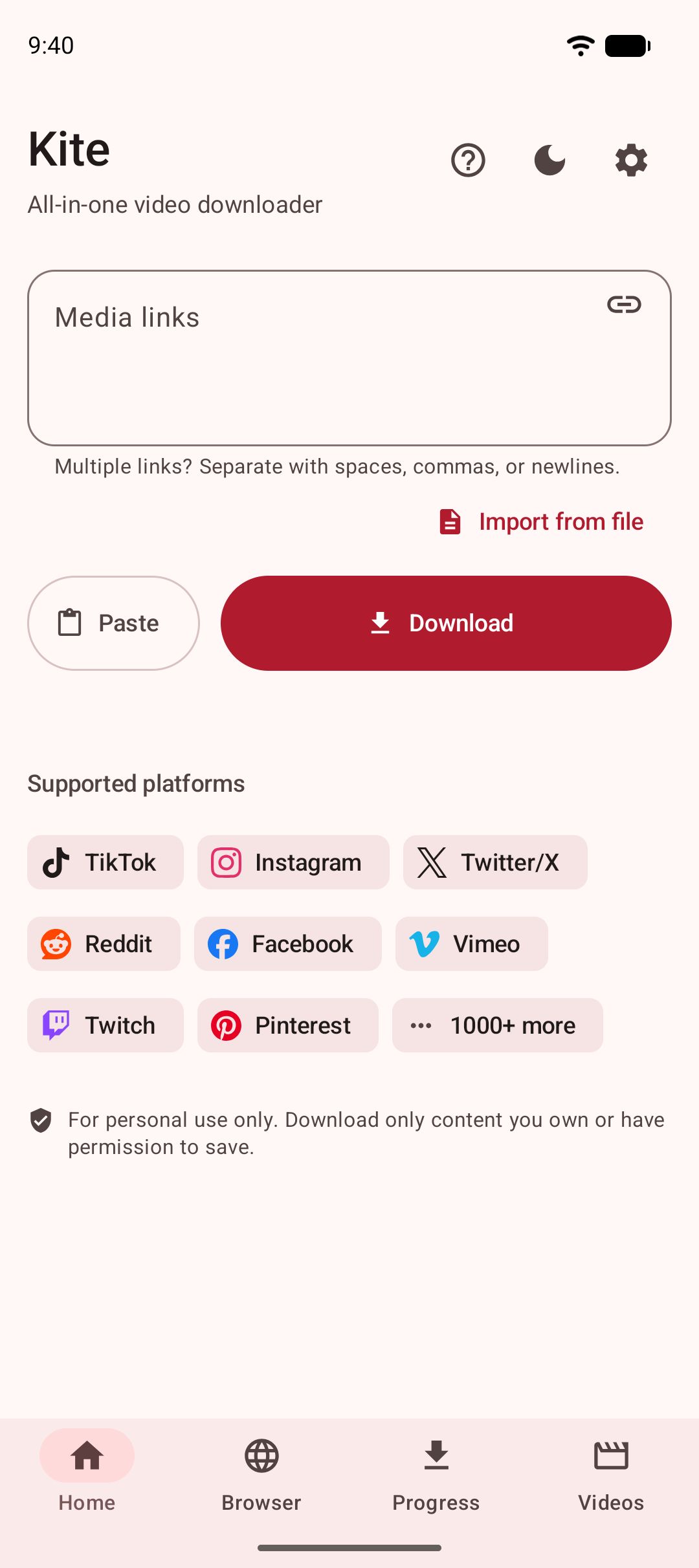
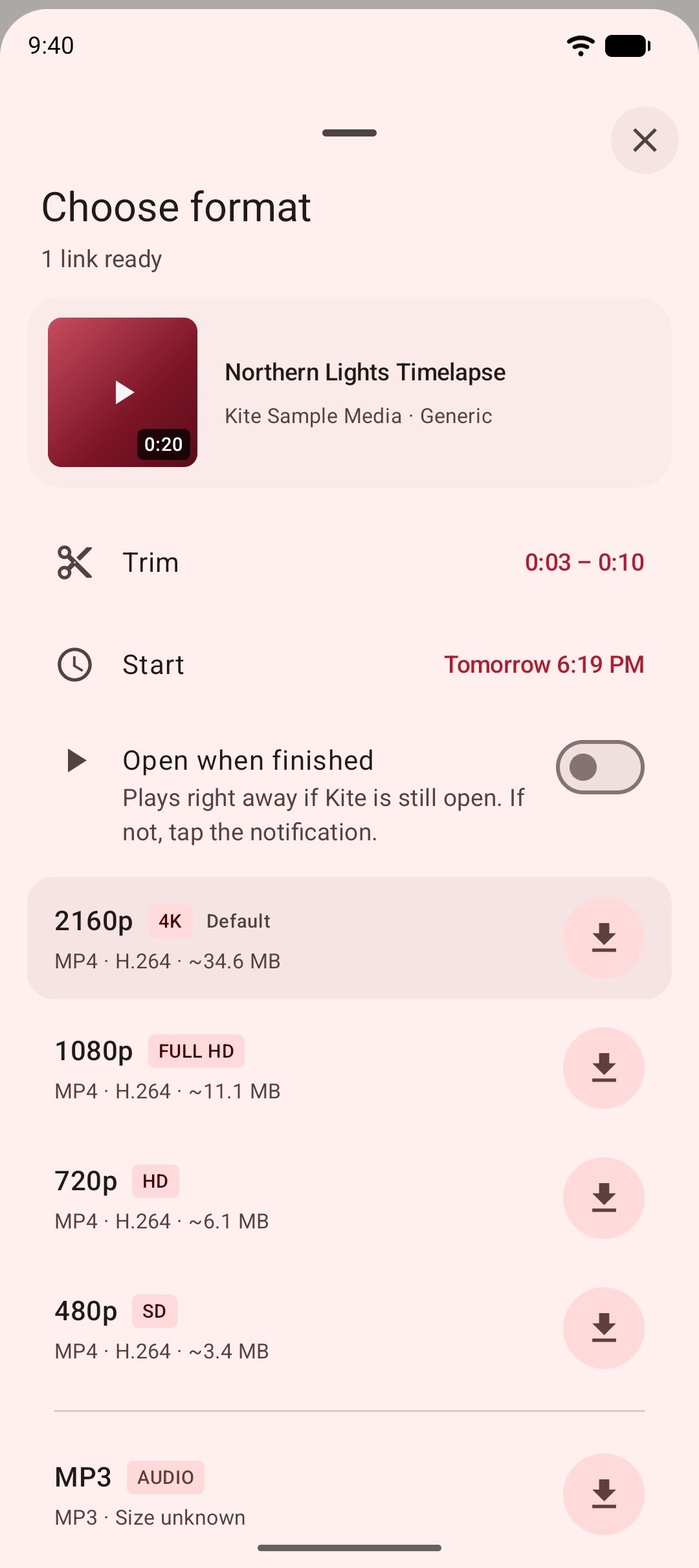
Kite is distributed through Google Play and requires Android 7.0 or newer (as of August 2026). It is free with ads and needs no account or sign-up. Paste a TikTok link and Kite works out what is on the page using yt-dlp, running entirely on the phone, then lists every resolution the source offers with container, codec and estimated size. Or it pulls the audio out as an MP3 with title and artist metadata embedded, which is the piece SnapTik’s FAQ says it will not do. A built-in browser spots playable media on pages you visit and offers to save it, which covers links that arrive as web pages rather than inside the TikTok app.
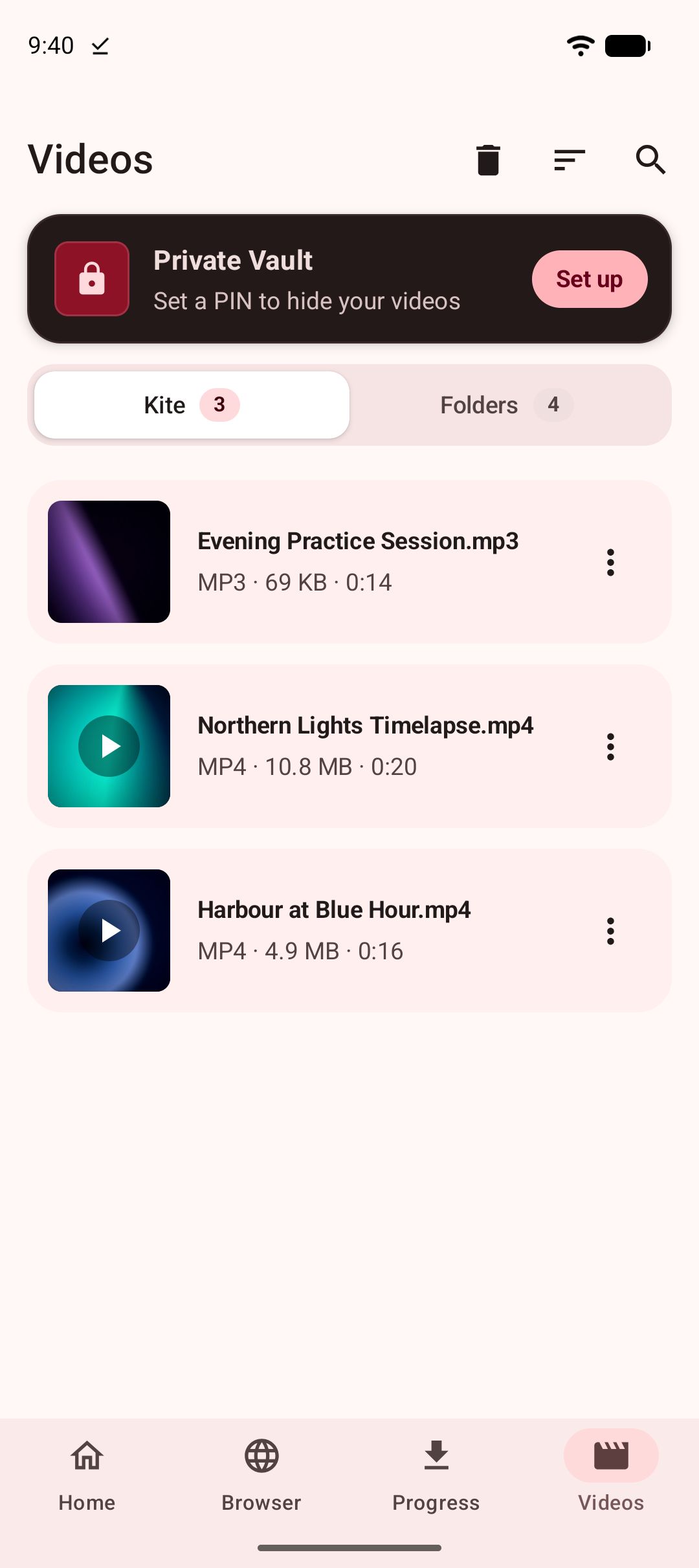
The download side is where the browser-tab loop ends. Up to three downloads run at once with live speed and ETA in the notification shade; they survive closing the app, pause and resume, and can be scheduled or held to Wi-Fi. A playlist link is expanded and offered item by item, and a trim range saves part of a video. Finished files land in a Kite folder that gallery and file apps can see, and in a searchable in-app library alongside the phone’s existing videos and music. The player has swipe gestures, picture-in-picture and a queue, and saved MP3s keep playing with the screen off, with lock-screen controls. A PIN-locked, encrypted Private Vault hides chosen files from the gallery, and vault files stay on this device.
The honest negatives. Kite shows ads, a banner and the occasional interstitial, and there is no paid tier that removes them. Its scope is also narrower than a sideloaded downloader’s: there are certain large video and music platforms that Google Play policy does not allow downloader apps to touch, and Kite deliberately excludes them. TikTok is not affected by that boundary. Kite does not bypass copy protection of any kind: material protected by DRM is declined rather than downloaded.
Seal
Seal is a free, open-source Android downloader built on yt-dlp, distributed through GitHub releases and F-Droid (as of August 2026). It is GPL-3.0 licensed and funded by donations, with no advertising and no Google Play listing, so installing and updating means F-Droid or a GitHub APK. The feature set is deliberately compact: one-click playlist downloads, metadata and thumbnails embedded into extracted audio, subtitles embedded into videos, an embedded aria2c as an optional external downloader, and custom yt-dlp command templates. The interface is Material Design 3 with dynamic colour.
For TikTok, Seal behaves like the other extractor apps: it saves the stream the page serves. The newest build on F-Droid is 1.13.1, added in January 2026, and it requires Android 5.0 or newer; F-Droid also notes that the app relies on the GitHub API to check for and fetch yt-dlp engine updates. Seal fits someone who wants an ad-free, open-source replacement and does not mind sideloading.
YTDLnis
YTDLnis is a free, open-source Android downloader that uses yt-dlp and runs on Android 7.0 and above (as of August 2026). Its README lists GitHub, F-Droid, IzzyOnDroid and Uptodown as the only trusted sources, and the repository showed commits as recent as August 2026.
It is the deepest of the three. The README describes playlist processing where every item can be edited separately, a download queue with scheduling by date and time, multiple simultaneous downloads, batch import of links from a .txt file, and a share-menu card that downloads without opening the app. Beyond that: cookie support for signing in with your own account, cutting downloads by timestamps or chapters, SponsorBlock handling, custom yt-dlp commands with a built-in terminal, and download logs. If you are leaving SnapTik because twenty links in a week is normal for you, this is the one built for it. The trade is the learning curve and a sideloaded install.
Side by side
Competitor rows summarise each tool’s own page, README or listing, as of August 2026.
| Feature | SnapTik | SSSTik | Kite | Seal | YTDLnis |
|---|---|---|---|---|---|
| Type | Web tool | Web tool | Android app | Android app | Android app |
| Where to get it | In a browser, nothing to install | In a browser, nothing to install | Google Play | GitHub, F-Droid | GitHub, F-Droid, IzzyOnDroid, Uptodown |
| Price model | Free, ad-supported | Free; monetisation not stated on its page | Free with ads | Free, open source; donations | Free, open source; donations |
| Batch or queue | No, one video at a time per its FAQ | Not stated on its page | Three at once, rest queued, plus scheduling | Playlist in one click | Queue, scheduling, several at once |
| MP3 | Audio button only; no music-track service | Yes, MP4 or MP3 | Yes, with title and artist tags | Audio with embedded metadata | Audio downloads |
| Library and player | No, the file lands in your downloads | No, the file lands in your downloads | Searchable library plus player with queue and PiP | Manages its own download list | Download list with logs |
Bottom line
Pick by how often you save, and on what device.
- One clip now and then, or you are not on Android. Stay with the web tools. SnapTik if you want photo slideshows merged into an MP4; SSSTik if you want a plain MP4-or-MP3 choice and you are working on a desktop browser.
- Several clips a week on an Android phone. An app removes the loop that made you search for an alternative. Kite is our case for it: a Google Play install, a quality picker, MP3 with tags, background downloads that resume, a library and a player. Go in knowing it shows ads and that it excludes the large platforms Play policy keeps downloader apps away from.
- You want no ads and open source. Seal, if a compact tool installed from F-Droid suits you.
- You batch, schedule and tinker. YTDLnis, for the queue, the scheduling, the cookie sign-in and the command templates.
For the wider field of TikTok tools, including how these compare with the app-store utilities, see our roundup of the best TikTok downloaders with no watermark. Whichever route you take, the ground rules do not change: these are tools for personal use, so save only content you own or have permission to save, respect the terms of the sites you visit, and respect the rights of the people who made what you are watching.