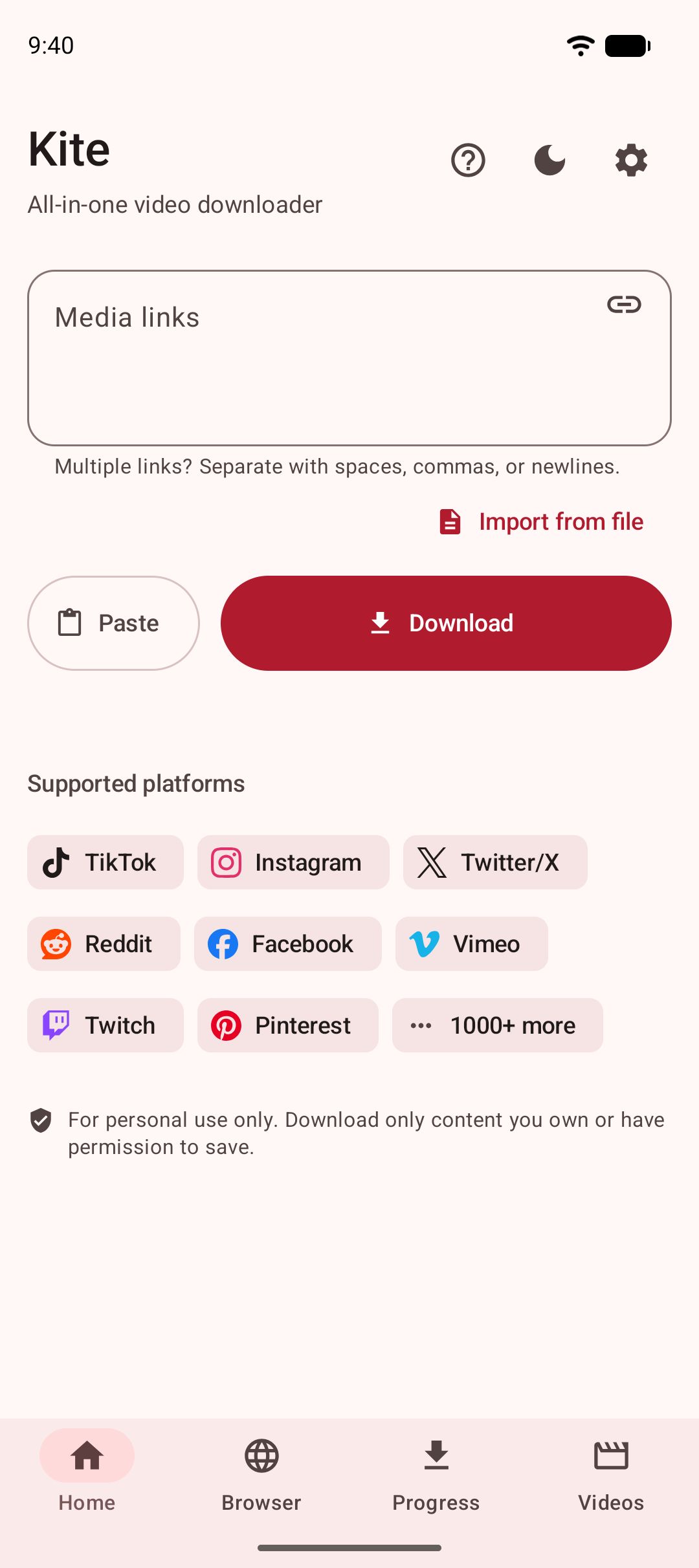
Copy the video’s link from TikTok’s share sheet, open Kite: Video Downloader, and paste it. Pick a resolution from the list and the file lands in a folder your gallery can see, in most cases with no watermark burned into the picture.
That last part is the whole reason this search exists. TikTok’s own save button renders a copy with the moving watermark and username baked in, and it is unavailable when the poster disables downloads. A downloader takes a different route: it reads the page and fetches the stream the page itself plays. This guide covers the flow on Android, photo-mode posts and audio-only saves, and the four things that most often stop a save. The limits are real and worth stating first: public pages only, and no tool can undo a watermark that is already part of the image.
What you need
- Kite: Video Downloader, from Google Play. It runs on Android 7.0 and newer, with no account and no sign-up. It is free and supported by ads — a banner and the occasional interstitial — with no subscription.
- The link to the TikTok post you want to save. Public posts only: Kite reads a page the way a logged-out visitor does.
- A few minutes and some free storage. Kite shows an estimated size next to each quality, so you can see what a save costs before it starts.
Everything happens on the phone. The extraction engine is yt-dlp, running locally, so there is no browser tab to paste into and no Kite server in the middle.
Step by step
-
Copy the link in TikTok. Open the video full-screen, tap Share, then Copy link. Both link shapes are fine: the long
tiktok.comaddress and the shortvm.tiktok.comone the share sheet usually produces, which Kite follows to whichever post it points at. Photo slideshows are the one exception — see below. -
Open Kite and tap Paste. The link goes into the box on the Home tab with nothing to type; switch on Auto-paste links in Settings and Kite pastes it for you when it opens. Kite reads the page and works out what is on it.
-
Or find the video in Kite’s built-in browser. If the video reached you as a web link, open the Browser tab and go to the page there. Kite watches for playable media on the pages you visit and offers to save what it finds. This is also the route to try when a link will not copy cleanly.
-
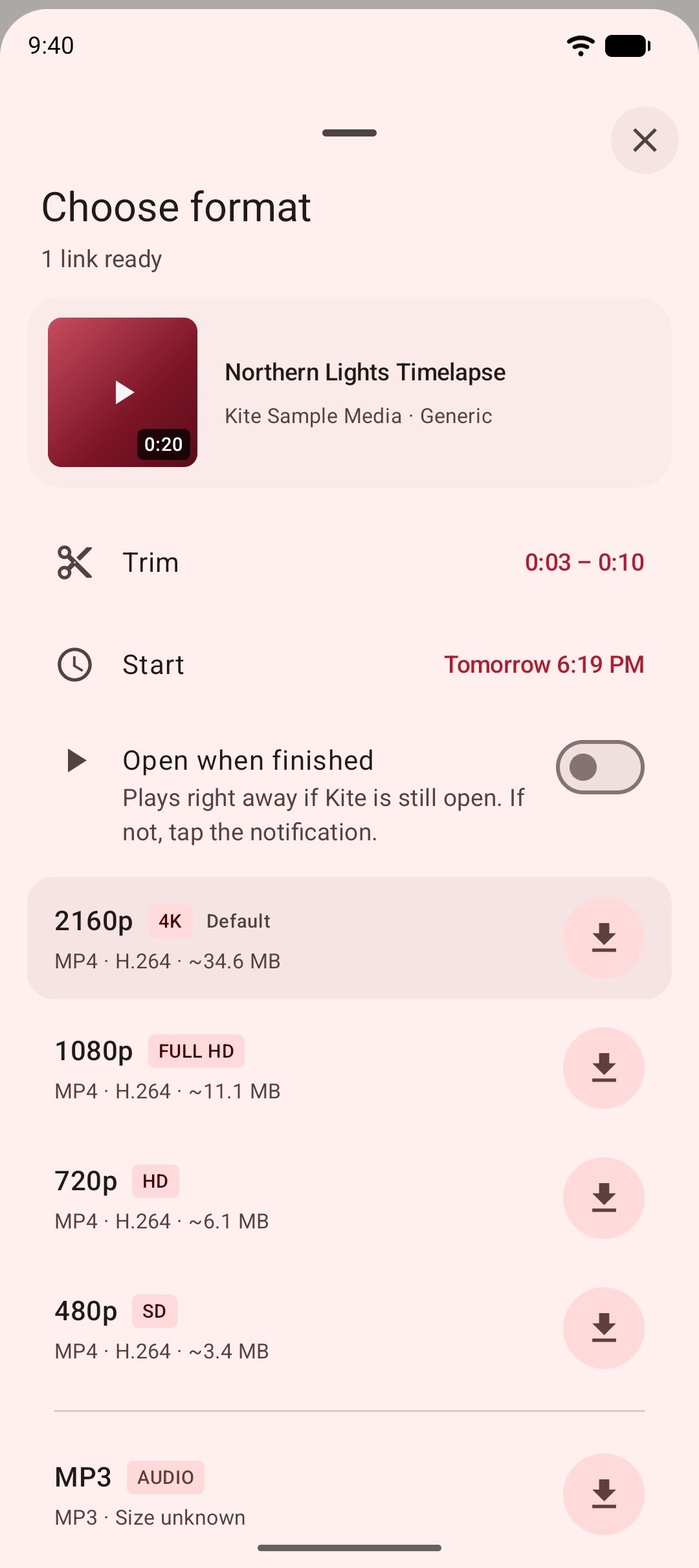
Pick a quality, or choose audio only. Kite lists every resolution the source offers — SD up to 4K where TikTok has it — with the container, the codec and an estimated size beside each one. The same sheet holds the audio-only option, a trim range if you only want part of the clip, and a scheduled start time.
-
Let it download in the background. Up to three downloads run at once, with live speed and time remaining in the notification shade, plus pause, resume and cancel. Downloads survive closing the app, and an interrupted one resumes instead of starting over. You can queue the next link while the first is still going.
-
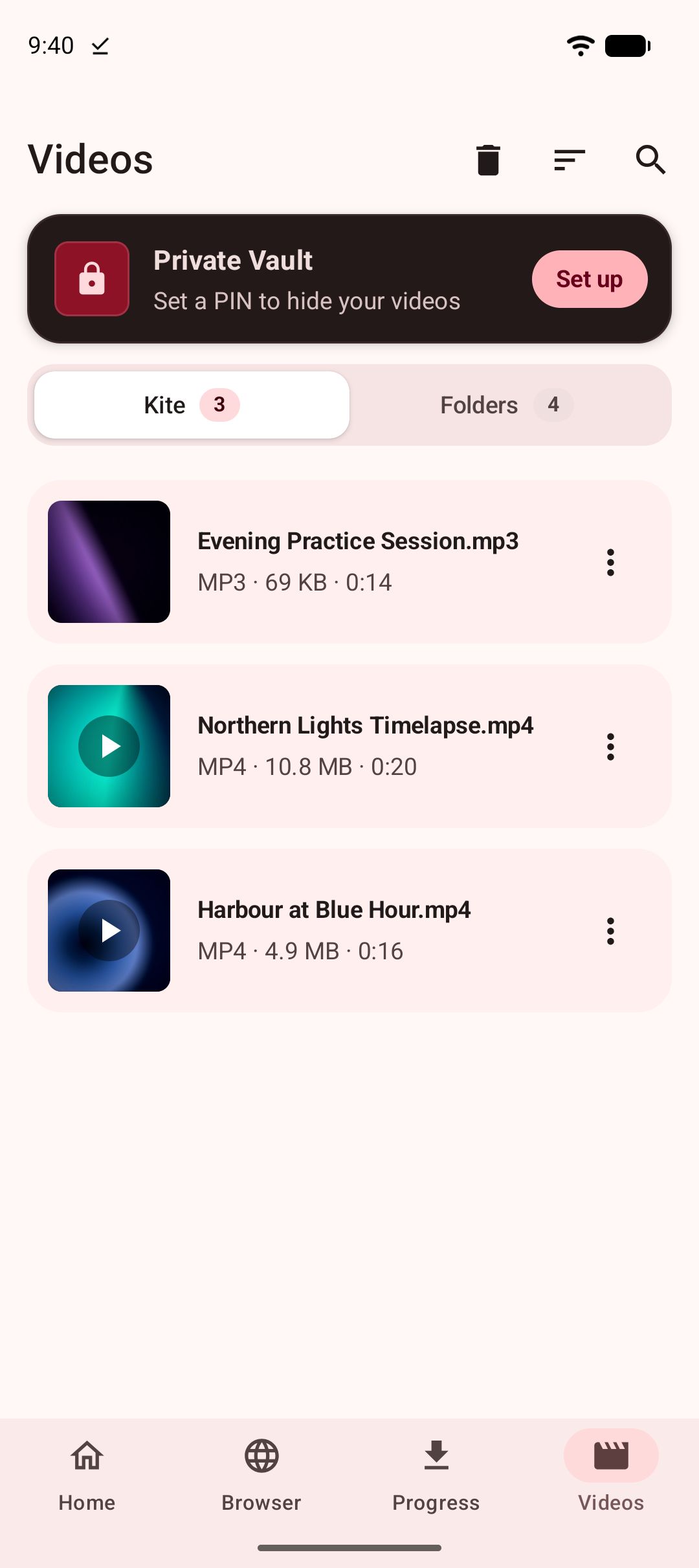
Find it in the library. Open the Videos tab. It holds everything Kite has saved alongside the video and music already on the phone, grouped by folder and searchable, and saves land in a Kite folder that gallery and file apps can see. Tap one to play it in place: swipe for brightness, volume and seek, hold for double speed, skip in ten-second steps, or pop it into picture-in-picture.
-
Optional: move it into the Private Vault. Files you would rather keep out of the gallery can be moved into the vault, where they are encrypted and PIN-locked. Everything in the vault stays on this device.
Why some saved videos still carry a watermark
Here is the part most pages skip. Kite saves the video stream the page actually plays, which for most public TikTok videos is the version without the burned-in watermark; where TikTok serves only a watermarked stream, that is what any downloader gets. The overlay is drawn into the pixels, so once a stream carries it, no app can lift it back out.
The contrast with TikTok’s own button is what makes this worth doing. That button always produces the watermarked export, and it disappears when the poster disables downloads. Reading the page gets you whatever the page has, usually the cleaner file — a consequence of how the platform serves video, not a trick, and not a guarantee.
Photo-mode posts, and saving only the sound
Photo mode is the common edge case, and the short answer is that a slideshow holds no video, so no MP4 comes out of one. It is worth knowing exactly how that shows up. TikTok shares a slideshow under an address with /photo/ in it, and that address shape is not one the extraction engine recognises at all, so Kite answers This URL is not supported rather than grinding away at it. Swap /photo/ for /video/ in the address and the post does open — but the sheet then holds a single row, the sound as an MP3. Some web tools advertise merging those images and the audio into a video file on their end; our guide to web-based TikTok tools and their alternatives covers that route, and we leave the claim with them.
For sound on its own, the audio-only option writes an MP3 with title and artist metadata embedded. If you already saved the video, Kite can convert it afterwards instead — our video to MP3 guide walks through both directions. Saved MP3s keep playing with the screen off, with controls on the lock screen and over Bluetooth.
The same flow works beyond TikTok. Kite recognises media pages from Instagram — our guide to saving Instagram Reels uses the identical steps — as well as X (formerly Twitter), Reddit, Facebook, Vimeo, Twitch and Pinterest, plus a thousand or so other sites. Two exceptions are deliberate: certain large video and music platforms that Google Play policy does not allow downloader apps to touch; Kite deliberately excludes them. To compare tools before installing one, our round-up of TikTok downloaders sets Kite next to the open-source apps and the web tools.
If it does not work
The video is from a private account
Kite saves from public pages. If the account is private, the page a downloader can reach holds no playable stream, so extraction fails rather than producing a broken file. No setting changes this. If you need the clip, ask the person who posted it to send you the file.
The poster disabled sharing
Creators can turn downloads and sharing off. That removes TikTok’s own save button, and it can also mean there is no shareable public page to read. If TikTok will not give you a link for the post, there is nothing for a downloader to work with.
You copied the profile link instead of the video link
This is the most common failure, and the easiest to fix. Sharing from a profile screen gives a link to the account rather than to the post, so the page holds a feed instead of one video. Open the video full-screen first, then use Share and Copy link. A single-video link ends in a long numeric video id; a profile link ends in an @username.
Wi-Fi-only is on and you are on mobile data
Kite has a Wi-Fi-only setting. With it switched on, a download waits instead of starting while you are on mobile data, which looks like nothing happening. Join a Wi-Fi network or turn the setting off in Settings, and check you are online — an extraction needs a connection before it can read the page.
One more limit is deliberate rather than a fault. Kite does not bypass copy protection of any kind: material protected by DRM is declined rather than downloaded. Ordinary TikTok posts are not affected, but you may meet this on other sites.
The legal bit
Kite is a tool for personal use. Save only content you own or have permission to save, respect the terms of the sites you visit, and respect the rights of the people who made what you are watching. A clean copy of someone else’s clip is still their work, so keep it for offline viewing rather than reposting it without credit, and read TikTok’s terms before using a saved video for anything beyond watching it yourself.